Key Takeaways
Long-term care is help with daily living — bathing, dressing, eating, getting around — when a chronic illness, disability, or a cognitive condition like Alzheimer's means you can't manage on your own. It includes home health aides, adult day care, assisted living, and nursing home care.
Medicare does not pay for long-term custodial care. It covers a limited skilled-nursing stay after a hospitalization, and limited home health and hospice — not ongoing help with daily living. Medicaid pays only after you've spent down most of your savings.
Care is expensive and getting more so. Recent national surveys put a semi-private nursing home room above $100,000 a year and assisted living above $70,000, with costs rising faster than general inflation for two decades.
Traditional long-term care insurance has a track record of painful premium increases. Many people who paid for years were priced out right when they were most likely to need it. And if you never need care, you get nothing back.
Hybrid life and annuity policies are the modern answer. They pay leveraged benefits for long-term care if you need it — and if you don't, you still have a death benefit or an account value. The premium is typically guaranteed, so it can't be raised on you later.
Hybrids can be funded with qualified money (IRA, 401(k)) or non-qualified money, which means the account you never touch can become your care plan without changing how you live.
Policies have an elimination period (a waiting period before benefits begin) and a benefit period or benefit pool (how much they'll pay). Both are choices you make when you buy.
The best time to plan is while you're healthy enough to qualify. Hybrid products are available at ages traditional policies often weren't, but health still decides what's available.
If you've started researching what happens if you or a parent someday needs extended help with daily living, you've probably run into the term "long-term care insurance." It's one of the least understood corners of the insurance world, largely because most people assume Medicare has it covered. It doesn't. Here's what long-term care actually is, what it costs, why the old way of insuring it stopped working, and what we recommend instead.
What Is Long-Term Care?
Long-term care is the help people need when they can no longer fully take care of themselves — because of a prolonged illness, a physical disability, or a cognitive impairment such as Alzheimer's disease. Regular health insurance is built to treat and cure medical problems. Long-term care is about something different: maintaining your daily life when you can't manage the basics on your own.
It covers more ground than most people expect:
Help with daily activities like bathing, dressing, and eating
Home health care from a licensed aide or nurse
Adult day care
Respite care so a family caregiver can take a break
Hospice care
Assisted living
Skilled, intermediate, or custodial care in a nursing home
Coverage generally pays a fixed amount per day or per month toward these services, as long as the care comes from a provider licensed by the state.
How Much Does Long-Term Care Actually Cost?
This is where it gets real. Recent national cost-of-care surveys put the numbers roughly here:
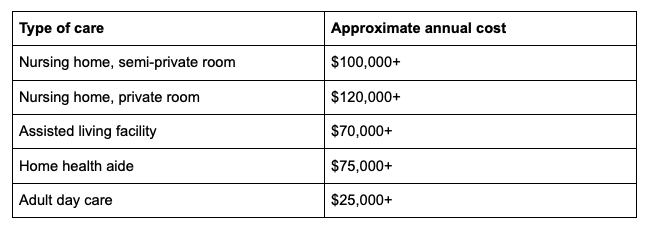
These are national medians, and they vary by two or three times from the least to the most expensive regions. What doesn't vary is the direction: long-term care costs have outpaced general inflation for two decades, driven by labor shortages and an aging population.
Put it in household terms. A couple who spent thirty years building a $400,000 nest egg can watch a single three-year care event take most of it — and leave the surviving spouse to finish retirement on what's left.
Why Doesn't Medicare Cover This?
It's the most common and most expensive misconception in retirement planning.
Medicare does not cover long-term custodial care. It pays for a limited stay in a skilled nursing facility after a qualifying hospital stay, plus limited home health and hospice. It was never designed to pay for ongoing help with daily living.
Medicare Supplement plans fill gaps in Medicare — deductibles, coinsurance — but generally don't pay for long-term care either.
Medicaid does cover long-term care, including nursing homes, but only for people with low income who have spent down most of their savings. Many families pay out of pocket until they qualify.
Employer or retiree health insurance typically stops once care becomes custodial rather than medical.
That gap — between what Medicare covers and what care actually costs — is what long-term care coverage exists to close.
The Problem With Traditional Long-Term Care Insurance
For decades, the answer was a standalone long-term care policy: pay an annual premium, and if you ever need care, the policy pays. Two things went wrong.
The premiums didn't hold. Insurers underpriced these policies badly, and many have raised premiums drastically over the years — in some cases making coverage unaffordable to keep after people had paid in for a decade or more. So right when someone was most likely to need the coverage, they could no longer afford to pay for it.
It was use-it-or-lose-it. If you paid premiums for twenty-five years and never needed care, the money was simply gone. No cash value, no death benefit, nothing to the family.
High cost and no benefit if you don't have a care event have made traditional long-term care policies largely a thing of the past.
The Modern Answer: Hybrid Life and Annuity Policies
Hybrid policies attach long-term care benefits to something you'd want anyway — a life insurance policy or an annuity. They solve both problems at once.
If you need care, the policy pays leveraged benefits for long-term care — typically a multiple of what you put in, paid out monthly for a set number of years.
If you don't need care, you still own something. A hybrid life policy leaves a death benefit to your family. A hybrid annuity keeps its account value, which can pay you income or pass to your beneficiaries.
The cost is locked. Most hybrids are funded with a single premium or a fixed schedule of premiums that the insurer can't raise. The painful rate-increase letters that defined traditional policies don't happen here.
They're available for both qualified and non-qualified money. That's the piece that changes the conversation. The IRA you never planned to touch, the old 401(k), the brokerage account with no job — any of it can be repositioned into a hybrid that protects the rest of your savings from a care event. Nothing about how you live changes. Tax treatment differs between qualified and non-qualified funding, so this is a decision to make with your CPA in the room.
Many of the life insurance policies we work with also include accelerated benefit riders that pay out part of the death benefit early for a terminal illness, a nursing home stay, home health care, or a chronic illness — so a policy bought for legacy does double duty.
How the Coverage Works
A few structural features show up in almost every policy, traditional or hybrid:
Elimination period. A waiting period, often 30 to 90 days, that you cover out of pocket before benefits begin. Think of it as a deductible measured in days.
Benefit period or benefit pool. How long the policy will pay, or the total amount available. Longer and larger cost more.
Monthly benefit amount. The maximum paid per month of care. If your actual cost exceeds it, you cover the difference.
Inflation protection. An optional rider that grows the benefit over time so it keeps pace with rising care costs.
Who Should Plan for Long-Term Care?
You have savings you want to protect. If a care event could erase what you've built, coverage preserves it.
You have a spouse or partner. A care event hits the household twice — once in the cost, and again in what's left for the person who's still here.
You're healthy enough to qualify. Health still decides what's available, though hybrids are often available at ages and health profiles traditional policies weren't.
You have money you don't need to live on. That's the money a hybrid is built for. If your income is limited to Social Security and there are no assets to protect, Medicaid becomes the backstop, and coverage may not be the right use of what you have.
Alternatives
Long-term care partnership policies, available in many states, let you keep more of your assets while still qualifying for Medicaid if your benefits run out.
Self-funding — setting aside savings earmarked for care — works for people with substantial assets who'd rather carry the risk themselves. The risk is that the earmarked money and the rest of the savings tend to blur together when the bills start.
Tips Before You Buy
Ask whether the premium is guaranteed. If it isn't, ask for the company's history of rate increases.
Ask what you keep if you never need care — death benefit, account value, or nothing.
Confirm whether the policy can be funded with qualified money, and talk to your CPA about the tax treatment either way.
Check the carrier's financial strength rating from A.M. Best, S&P, Moody's, or Fitch.
Read the policy before signing, and have your agent walk through the elimination period, benefit pool, and any inflation rider.
Consider your family's health history along with your own. Cognitive conditions often run in families.
Frequently Asked Questions
Does Medicare cover long-term care? No. Medicare covers a limited skilled-nursing stay after a hospitalization and limited home health and hospice. It does not pay for ongoing custodial care.
What is a hybrid long-term care policy? A life insurance policy or annuity with long-term care benefits attached. If you need care, it pays leveraged benefits. If you don't, you keep a death benefit or account value. Premiums are typically guaranteed.
Can I use my IRA or 401(k) to fund long-term care coverage? Yes. Hybrid products are available for qualified funds. The tax treatment differs from non-qualified money, so involve your CPA.
Why did my parents' long-term care premiums keep going up? Traditional standalone policies were underpriced for decades, and insurers raised rates to catch up. Hybrid policies were built to avoid that problem.
Does long-term care coverage include home care? Yes. Most policies cover home health aides, and many cover adult day care and respite care — not just nursing homes.
At what age should I plan for long-term care? While you're healthy. Hybrids are available later in life than traditional policies often were, but a health change can still limit your options.
The Bottom Line
Long-term care is the extended, non-medical help many people eventually need — and the one big retirement expense Medicare doesn't touch. The old answer, a standalone policy with premiums that could be raised and nothing to show if you never used it, has largely stopped working. The modern answer is a hybrid life or annuity policy: leveraged benefits if you need care, a death benefit or account value if you don't, a cost that can't be raised on you, and the option to fund it from money you weren't living on anyway.
Care on your terms. Savings that stay yours. A plan built around you
Living Tree Life & Legacy works with dozens of carriers. Guarantees are backed by the claims-paying ability of the issuing insurance company. This article is educational and is not tax or legal advice.