Key Takeaways
An annuity is a contract with a life insurance company. You pay a premium — once or over time — and the insurer guarantees to pay you income on a regular schedule, often for the rest of your life. It's the closest thing most retirees can get to a personal pension.
Annuities do three jobs: guaranteed lifetime income, protected growth on money you don't need to live on, and a direct handoff of remaining value to named beneficiaries. Most people need one of those jobs done; some need all three.
Two timing categories: immediate annuities start paying within a year; deferred annuities grow first and pay later, on a date you choose.
Three growth categories: fixed (a guaranteed rate), fixed index (growth linked to a market index with a floor of zero, so no principal is lost to a downturn), and variable (invested in subaccounts, with real market risk and SEC regulation).
A joint-life income rider keeps paying the surviving spouse. When one spouse dies, the household loses a Social Security check and often part of a pension — guaranteed income on two lives is the transition plan.
Income from a qualified annuity counts toward required minimum distributions, which begin at age 73 (75 for those born in 1960 or later).
Growth is tax-deferred, not tax-free. Gains are taxed as ordinary income when withdrawn, and heirs generally owe income tax on gains they inherit — which is why life insurance often handles the legacy job better.
Annuities are long-term contracts. Surrender periods commonly run six to ten years, and withdrawals before age 59½ generally carry a 10% penalty. Fund them with money you won't need soon.
A guarantee is only as good as the insurer behind it. Check the carrier's financial strength rating from A.M. Best, S&P, Moody's, or Fitch before you buy.
Your parents probably had a pension. A check showed up every month, for life, and nobody had to watch the market to know it would keep coming. Most of us don't have that anymore. We have a 401(k), an IRA, and a nagging question: how do I make this last as long as I do?
An annuity is the tool built to answer that question. Here's what it is, the three jobs it does, and the honest things to know before you buy one.
What Is an Annuity?
An annuity is a contract with an insurance company. You put money in — once, or over time — and the company makes you a guarantee in return. The guarantee is the whole point. A brokerage account can grow, but it can't promise anything. An annuity can promise a paycheck you can't outlive, growth you can't lose, or a clean handoff to the people you love. Which promise you need depends on what the money is for.
How You Pay Into an Annuity
Single premium: you pay once, usually with a lump sum — an inheritance, a brokerage account with no plan attached to it, or a rollover from a 401(k) or IRA.
Flexible premium: you pay over time, which suits people still building toward retirement.
Immediate vs. Deferred Annuities
Immediate annuities are bought with a lump sum and start paying within about a year. They fit people already retired who want to convert savings into a paycheck now.
Deferred annuities grow first and pay later. During the accumulation phase your money grows, tax-deferred, according to the type of annuity you own. In the payout phase you begin receiving income — for a set period or for life. Most deferred annuities include a death benefit, so if you die before payout begins, the value goes to your beneficiaries.
The Three Jobs an Annuity Does
Job one: income you can't outlive
Social Security and a pension, if you have one, are the only income most people have that's guaranteed for life. Everything else is a pile of money you're hoping to draw down at the right pace. Draw too fast and you run out. Draw too slow and you live smaller than you had to. Retire into a bad market and the math gets worse before you've started.
An annuity with a lifetime income rider turns a piece of that pile into a third guaranteed check. It doesn't stop when the market drops, and it doesn't stop when the account balance runs out. It stops when you do — and set up as joint-life coverage, it doesn't even stop then. It keeps paying your spouse.
That matters more than most people realize. When one spouse dies, the household loses the smaller Social Security check outright, and often half or more of a pension. The survivor is left with less income and, because they now file single, a lower threshold before their Social Security is taxed. Income guaranteed on two lives is a transition plan for the person who's left.
Income riders do one more thing quietly: if the money came from an IRA or 401(k), the payments count toward your required minimum distributions. The IRS is going to make you take that money out starting at 73. An income rider takes it out on a schedule you chose.
Job two: growth you can't lose
Not all of your money is for income. Some of it is just sitting there — a brokerage account you never touch, an inheritance, savings well past what you'd need in an emergency. You'd like it to grow. You would very much like it not to shrink.
A fixed index annuity is built for exactly that money. Growth is linked to a market index like the S&P 500, but with a floor: when the index falls, you lose nothing. In exchange, the insurer caps how much of the gain you capture in a good year. You trade some of the upside for all of the downside. For money you don't need to live on, that's often a trade worth making.
Job three: passing it on
Some annuities carry a death benefit rider that pays your beneficiaries an enhanced amount when you pass — directly, to the people you name, without probate.
Here's the honest note most annuity pages leave out: the growth inside an annuity is tax-deferred, not tax-free. Your heirs will generally owe income tax on the gains. That's still a good outcome for many families. But if leaving money to your kids is the main goal, and you're healthy enough to qualify, a single-premium life insurance policy usually does that job better, because a life insurance death benefit passes income tax-free. Sometimes the right plan is an annuity for the income and a life policy for the legacy. We'll tell you which is which.
Fixed, Fixed Index, and Variable Annuities
Fixed. A guaranteed interest rate. Simple, predictable, the least upside.
Fixed index. Growth linked to a market index, with a floor of zero. No principal lost to a market downturn; gains capped.
Variable. Your money is invested in subaccounts that behave like mutual funds. Real upside, real downside — you can lose principal. Variable annuities are securities regulated by the SEC and carry the highest fees.
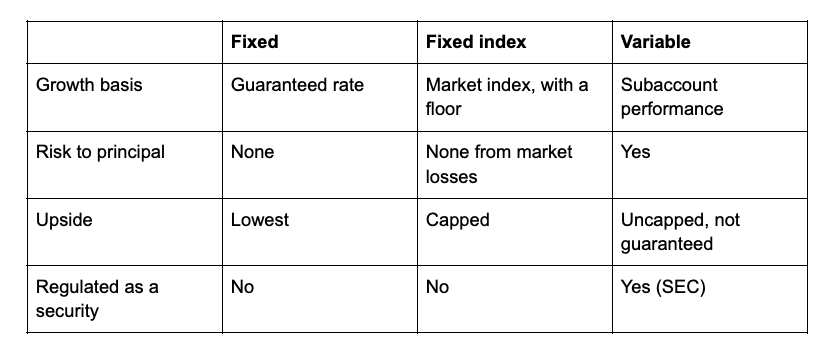
Our work centers on fixed and fixed index annuities, because they deliver a guarantee without a fee schedule that eats it.
Annuities and Taxes
Growth is tax-deferred. When you take money out, gains are taxed as ordinary income; the return of your original premium is not. Withdrawals before age 59½ generally add a 10% penalty on top. If the money came from a qualified account like an IRA, it stays qualified inside the annuity and the same rules — including required minimum distributions — follow it.
Fees and Surrender Charges
Surrender charges apply if you withdraw more than a set amount or cancel the contract within the surrender period, often six to ten years. That's the price of the guarantee, and it's why an annuity should be funded with money you won't need soon.
Rider fees cover lifetime income and enhanced death benefits. Worth it when they're doing a job you need; not worth it as decoration.
Mortality, expense, and subaccount fees apply mainly to variable annuities and are the main reason we rarely recommend them.
Who Are Annuities For?
Annuities make the most sense for people who are near or in retirement and want a guaranteed income floor on top of Social Security, who have money they don't need to live on and want it to grow without market risk, or who want to shift the risk of outliving their savings onto an insurance company.
They make less sense for people who need liquidity, have a short time horizon, or are chasing maximum growth.
Our guardrail: we generally keep about half of a client's investable assets outside annuities, and we make sure real liquid savings stay liquid. An annuity is a floor under your retirement, not the whole house.
Where the Money Comes From
The best annuity designs don't change how you live. They're funded from money you aren't living on — the account with no plan attached to it, the idle inheritance, the IRA about to start generating required withdrawals you didn't ask for. The income you count on every month stays exactly where it is. That's the rule we design around, and it's the first thing we'll figure out together.
Tips Before You Buy
Ask for the full fee schedule, including rider costs and the surrender charge schedule.
Check the carrier's financial strength rating from A.M. Best, S&P, Moody's, or Fitch. We work with dozens of carriers so we can pick the one whose strength and terms fit the job, not the one on the shelf.
Read the disclosure document — it spells out what's guaranteed, what isn't, and what it costs.
Know the surrender period before you fund anything.
Bring your CPA into any decision that touches your taxes.
Frequently Asked Questions
Is an annuity the same as life insurance? No — they're mirror images. Life insurance pays your family when you die. An annuity pays you while you're alive.
Can I lose money in an annuity? In a fixed or fixed index annuity, not to a market downturn — your principal is protected. In a variable annuity, yes.
What happens if I die before receiving all the payments? Most deferred annuities include a death benefit, so the remaining value goes to your named beneficiaries. Income riders can be set up so a spouse keeps receiving payments for life.
Does annuity income count toward required minimum distributions? Yes, if the annuity holds qualified money from an IRA or 401(k). Payments from a lifetime income rider count toward the RMD on that contract.
Are annuities a good short-term investment? No. Surrender charges and early withdrawal penalties make them the wrong tool for money you'll need in the next few years.
The Bottom Line
Retirement doesn't run on autopilot. An annuity is the closest thing most of us can get to the pension our parents had — a promise, in writing, from a company whose job is to keep it. Some are designed to pay you for life. Some grow your money without putting it at risk. Some are built to pass along what you've created, cleanly and quietly.
Income you can't outlive. Growth you can't lose. A plan built around you.
Living Tree Life & Legacy works with dozens of carriers. Guarantees are backed by the claims-paying ability of the issuing insurance company. This article is educational and is not tax or legal advice.